ABP Induction has given a positive assessment of its participation at Inter Foundry in Coimbatore
India is emerging as one of the most dynamic markets for foundry technology. For ABP Induction, Inter Foundry/Inter DieCast 2026 was therefore much more than a typical trade show appearance: Numerous discussions at the booth focused on new plant concepts, electrification, energy efficiency, and digitalization. ABP CEO Till Schreiter also addressed these topics in his keynote speech and highlighted the role that induction technology can play in the transformation of aluminum, copper, and die-casting production.
The Inter Foundry in Coimbatore gave ABP the opportunity to engage directly with customers, partners, and experts from one of the foundry industry’s most important growth markets. For ABP, the focus was primarily on the non-ferrous sector – and the response at the booth demonstrated just how intensely the industry is currently engaged in advancing its production processes.
The ABP India team played a major role in the success of the trade show appearance. Our colleagues participated in the numerous on-site meetings, contributed their knowledge of the Indian market, and, together with the international ABP team, ensured a strong presence in Coimbatore. It is precisely this direct exchange that is important to ABP: Global technological expertise must be combined with an understanding of local production conditions, requirements, and investment decisions.
India as a Growth Market
CEO Till Schreiter highlighted the opportunities this presents in his presentation titled “European Equipment for Indian Non-Ferrous Casting Production.” Naturally, the presentation then focused on induction technology. Using aluminum production as an example, Schreiter also demonstrated the potential of electrification. In the comparison shown, an induction furnace with the same melting capacity of 3.5 metric tons per hour achieves a specific energy consumption of approximately 440 kWh per metric ton, compared with 720 kWh per metric ton for the gas furnace under consideration – a reduction of approximately 39 percent. If induction is powered by renewable electricity, the technology also paves the way for very low direct emissions during the melting process.
From ABP’s perspective, electrification is thus increasingly becoming a matter of competitiveness. Productivity, energy consumption, metal yield, process quality, and decarbonization must be considered together. Modern induction technology provides an important technological foundation for this, complemented by intelligent process control, automation, and digital solutions.
Transformation is more than just a new furnace
One of the key messages of the presentation: Sustainable production cannot be achieved simply by replacing individual pieces of equipment. The starting point must be the specific production task. ABP therefore considers technology, processes, energy, digitalization, and future production requirements in conjunction with one another. Feasibility studies and simulations can be just as much a part of the process as developing a vision, evaluating different technologies, or providing support through commissioning and into ongoing operations. Digital solutions complement this approach. For example, ABP Intelligence supports process control and plant monitoring, while myABP provides key metrics, reporting, and maintenance planning to support strategic decision-making.
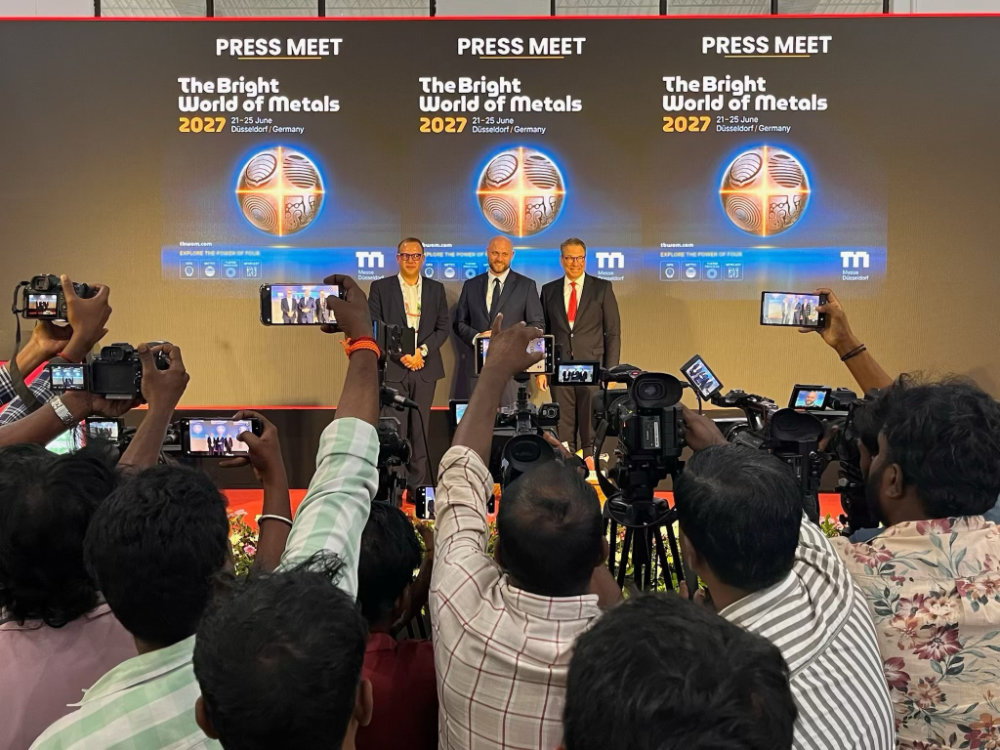
Our time in Coimbatore also offered a glimpse of the next major international industry gathering. Together with representatives from Messe Düsseldorf, Till Schreiter was also in India to promote The Bright World of Metals 2027 – the GIFA trade show in Düsseldorf. The event holds special significance for ABP: The company has traditionally been represented at GIFA in Düsseldorf, while Till Schreiter, as president of THERMPROCESS, has also assumed responsibility for the international trade show and the symposium on thermal processing technology.